

Shizuoka Prefecture — A Microcosm of Japan's LandscapeWhen planning a trip to Japan, many often consider popular cities like Tokyo, Kyoto, Osaka, Okinawa, and Sapporo, but Shizuoka Prefecture, located in the very center of Japan and bordering Kanagawa and Tokyo, is frequently overlooked. While Shizuoka Prefecture might not be familiar to many, the mention of Japan's tallest mountain, "Mount Fuji," surely brings instant clarity. Shizuoka Prefecture boasts a wealth of natural beauty, including the towering Mount Fuji, the magnificent Suruga Bay, and the tranquil Lake Hamana. The setting for the classic animated film "Crayon Shin-chan: Fierceness That Invites Storm! The Yakiniku Road of Glory," as well as the highly popular hot spring resorts of the Izu Peninsula and Atami City, are also in Shizuoka. It is lauded as "a microcosm of Japan's landscape" and "Tokyoites' backyard garden."
When visiting Shizuoka, the breathtaking views of Mount Fuji are not to be missed. Image credit:Shizuoka City Tourism Official Website

Although nearly 60% of Shizuoka's area consists of uninhabitable forests, it boasts a population of approximately 3.6 million, ranking tenth in Japan. The majority of its population densely resides in the plains, fostering a rich and robust industrial structure in Shizuoka. Shizuoka tea and seafood are considered blessings from the mountains and sea for its residents, while numerous hot springs and water activities drive tourism across the Izu Peninsula. Furthermore, the coastal Tokai Industrial Region houses large factories for many renowned Japanese brands, with the headquarters of various automobile, motorcycle, and musical instrument companies such as Honda, Suzuki, Yamaha, and Kawai Pianos all established here.
Numerous factories line the Tokai Industrial Region, creating a unique landscape alongside Mount Fuji, with its night view, akin to an industrial Disneyland, attracting many photography enthusiasts. Image credit:Sankei Shimbun


Japan's Number One in Assembled Model Production ValueModel kit enthusiasts will be familiar with the 37 model factories located here, including Tamiya, Fujimi, Aoshima Bunka Kyozai, and Bandai, making Shizuoka Prefecture the top city in Japan for plastic model kit exports. In 2020, the shipment value reached approximately 22.2 billion Japanese Yen, accounting for 92% of the national total. Leveraging this impressive achievement, the Shizuoka City government has collaborated with the Hakuhodo Group since 2020 to launch the "Shizuoka City Model Kit Project" for promotion. This initiative not only established the "Model Kit Promotion Section" within the Industrial Promotion Division and opened model workshops where visitors can experience model making, but also placed facilities such as mailboxes and public telephones designed in the shape of model kit sprues throughout the city, aiming to transform Shizuoka City into the "Model World Capital."
Mailboxes and public telephones have been transformed into adorable model kit designs. Image credit:Shizuoka City Tourism & Gourmet Blog "Minato-machi demo Sakura wa Sakur"

This April, a model kit sprue facility featuring the "Kintami Gusoku" armor, once worn by Tokugawa Ieyasu, was also added to Sunpu Castle's Ninomaru Bridge. Ieyasu, portrayed by Jun Matsumoto in the Taiga drama "Dousuru Ieyasu," also wore this very armor. Image credit:Hobby Town Shizuoka

In addition to government-planned tourist attractions, there is also the "Shizuoka Hobby Show," a large-scale exhibition held annually in Shizuoka City every May since 1959. It offers a sneak peek at the latest prototype models from all Japanese model manufacturers. Furthermore, there's the BANDAI HOBBY CENTER, a Bandai model factory with some facilities open for tours. This factory boasts the model industry's most advanced injection molding technology, Japan's only "4-color multi-injection molding machine," and is the sole production site for over 700 million Gundam model (Gunpla) kits, which are sold both domestically in Japan and worldwide.
The annual 'Shizuoka Hobby Show' grandly concluded its 61st edition this year, attracting a large number of model enthusiasts every year. Image credit:静岡ホビーショー

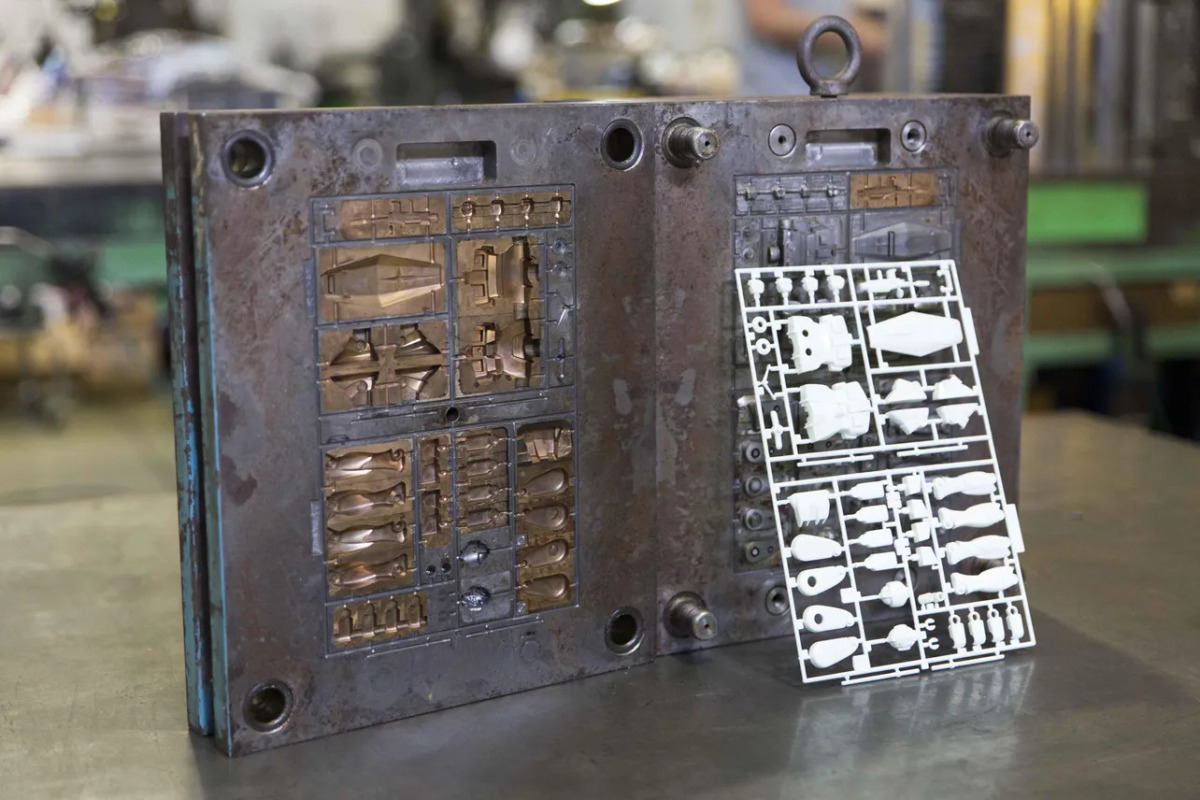
The 4-color injection molding machine used at the BANDAI HOBBY CENTER factory can simultaneously mold up to four different plastic materials and combine them into a single parts runner. Image credit:BANDAI SPIRITS

Many believe that Bandai, with its "Mobile Suit Gundam" series IP, undoubtedly deserves much credit for Shizuoka becoming the "Model Capital of the World," as its high-quality, cutting-edge products are indeed world-renowned. However, from a historical perspective, the person who truly fostered the development of Shizuoka's model industry might be attributed to Tokugawa Ieyasu, the Shogun who established the Edo Shogunate and is also the protagonist of this year's Taiga drama "Dō Suru Ieyasu?" (What Will Ieyasu Do?).
'Tokugawa Ieyasu,' one of the Three Great Unifiers of Japan, who founded the Edo Shogunate and ruled Japan for 264 years. This painting is a portrait of Tokugawa Ieyasu by Kano Tan'yū, an Edo period painter. Image credit:Wikipedia

Is Tokugawa Ieyasu the unsung hero who made Shizuoka the 'Model Capital of the World'?Let's rewind the timeline to Tensho 13 (1585 AD) during Japan's Sengoku period. The 42-year-old Tokugawa Ieyasu was active in the land now known as Shizuoka. After forming the Kiyosu Alliance with Oda Nobunaga, he fought hard to seize the territories of the Imagawa and Takeda clans. Later, during the chaos following Nobunaga's sudden death in the "Honnoji Incident," he acquired some territories left in a power vacuum, becoming a Sengoku daimyo ruling the five provinces of Mikawa, Tōtōmi, Kai, Shinano, and Kōzuke. At the same time, to reconstruct Sunpu Castle in Suruga Province into a modern castle with a "tenshu" (castle keep) and rebuild Sengen Shrine, which he himself had burned down, Ieyasu gathered a group of excellent carpenters and builders from across the country to participate in the construction.
The 'Burning of Honnoji Temple' by Yōsai Nobukazu, a renowned ukiyo-e artist of the Meiji era. Image credit:Wikipedia

As Ieyasu chose to submit to Hashiba Hideyoshi during the Battle of Komaki and Nagakute, with few battles, construction progressed very quickly. In just four years, from Tensho 13 to 17, Sunpu Castle successively completed projects such as the Honmaru Goten (main keep palace), tenshu, and fortifications. These summoned carpenters and builders naturally settled in the area. However, Ieyasu was not so lucky; less than five years after moving in, Toyotomi Hideyoshi, having unified the country, viewed him as a threat, and he was transferred to the Kanto Plain (which is now Tokyo and its six surrounding prefectures). It wasn't until 18 years later that he returned to Sunpu Castle to live out his retirement.
Today's Sunpu Castle has undergone multiple destructions and reconstructions and does not fully represent its appearance when Ieyasu completed its construction. Image credit:維基百科

Let's once again pull the timeline back to the 11th year of Kan'ei (1635 AD) during Japan's Edo period, when Tokugawa Iemitsu, the third Shogun of the Edo Shogunate, ordered the construction of the Sengen Shrine's main hall during his visit to Kyoto. Once again, a group of carpenters and lacquer craftsmen were summoned from across the country. After completion, many craftsmen chose to settle there, making Shizuoka a hub for outstanding woodworkers in later years. They not only applied their exquisite skills to building houses but later developed a unique local woodworking industry known as 'Suruga Sashimono'.
Shizuoka Sengen Shrine, rebuilt multiple times. Tokugawa Ieyasu held Sengen Shrine in great reverence throughout his life. Its wooden shrine building, the 'Ohaido' (Great Hall of Worship), brought together many excellent woodworkers from all over Japan, employing numerous advanced architectural techniques, and was hailed as Japan's finest wooden shrine architecture. Image credit:Wikipedia

Sashimono refers to handcrafted wooden products made using a ruler and measuring tools. Their appearance shows almost no visible joints, and they are not fixed with any metal nails, relying solely on mortise and tenon joints with extremely small tolerances to secure parts. Unlike 'Kyo-sashimono,' which originated from court culture and emphasized elegant aesthetics, and 'Edo-sashimono,' which originated from Edo culture and prioritized robustness, the 'Suruga Sashimono' passed down to today boasts precise and diverse processing techniques, employing the 'Kijiro-nuri' lacquering method that showcases the natural beauty of the wood grain. Originally, Suruga Sashimono primarily produced small-scale miscellaneous goods such as tea ceremony utensils, tableware, stationery, and small drawers. In modern times, it has combined with mechanical processing technology to create large items like tables, chairs, and cabinets, known as 'Sashimono furniture,' making it an extremely important art and culture in Shizuoka.
Sashimono craftsman's processing techniques. Image credit:Shizuoka Prefectural Folk Craft Promotion Association

It Turns Out These Major Model Manufacturers All Started by Developing Wooden ModelsAt this point, you might be full of questions: How can Tokugawa Ieyasu be considered the driving force? What do these woodworkers have to do with plastic assembly models? In reality, the predecessor of plastic assembly models was wooden models. Because such a group of woodworkers resided here, several model manufacturers specializing in wooden models were able to develop in this area later on, and they continued to drive the development of plastic assembly models using the precise carving techniques from wooden models. Taking Aoshima Bunka Kyozai Co., Ltd. as an example, after Jiro Aoshima retired as an aviator in 1932, he did not abandon his love for airplanes. He chose to start a business in Shizuoka, a region with a high concentration of woodworkers, becoming a developer of wooden airplane models.
Wooden airplane models sold by 'Aoshima Aircraft Research Institute' in the 1930s. Image credit:Hobby Plastic Models and Showa Tokusatsu Notes

TAMIYA, famous for its Mini 4WD models, saw its founder Yoshio Tamiya transition from the transportation industry after World War II. In 1948, he established a woodworking department to develop wooden models of airplanes and ships. Also founded during this period were HASEGAWA, FUJIMI, and other model manufacturers of varying sizes. They all coincidentally started businesses in Shizuoka in the 1940s, producing a wide variety of wooden models and educational materials.
TAMIYA Model Founder - Yoshio Tamiya. Image credit:Tamiya RC Classics & Moderns

However, this prosperity was short-lived. In the latter half of the 1950s, plastic models manufactured abroad began to be imported into Japan. These plastic models boasted more intricate details and were easier to paint than wood, causing sales of domestically produced wooden models in Japan to plummet. Manufacturers understood the adage 'if you can't beat 'em, join 'em' and began researching how to convert their model products to plastic. Naturally, Aoshima, Tamiya, Hasegawa, and Fujimi, mentioned earlier, all chose to rapidly switch tracks. While collaborating with external metal mold manufacturers, they also learned their techniques, and, starting in the 1960s, they successively launched their respective plastic assembly model products. From airplanes, tanks, ships, railways, cars and motorcycles, to even original sci-fi mechanical series, a wide variety of product types exploded onto the scene, sparking a craze and marking a brilliant beginning for Shizuoka's assembly model development history.
After World War II, plastic assembly model products from American manufacturers like Revell, Monogram, etc., began to be imported into Japan. Image credit:mercari

Starting in 1971, Shizuoka's four major model manufacturers – Tamiya, Aoshima, Hasegawa, and Fujimi – jointly launched the 1/700 ship model series 'WATER LINE SERIES'. Because each company was responsible for releasing the ships they were assigned, a peculiar situation arose where different model manufacturers shared the same brand. Image credit:Wikipedia

As for the familiar Bandai, it wasn't until the 1980s, with the release of its first Gundam model, the "1/144 RX-78-2 Gundam," that it truly rose to prominence – but that's another story.
The metal mold for the first Gunpla, "1/144 Gundam," displayed at the Shizuoka Gundam Factory "BANDAI HOBBY CENTER." Image credit:WEBザテレビジョン
Model Kits Offered at Tokugawa Ieyasu's Shrine If Tokugawa Ieyasu had not gathered master carpenters to construct Sunpu Castle back then, would Shizuoka Prefecture today still be able to house numerous model factories and be known as the 'Model World Capital'? Let's visit Kunōzan Tōshō-gū, located in Suruga Ward, Shizuoka City, atop Mount Kunō. This shrine was built by Tokugawa Hidetada in 1616 to enshrine his father, Tokugawa Ieyasu, after his death, marking the beginning of Ieyasu being revered as "Tōshō Daigongen." Inside the shrine, one can behold the magnificent architecture designated as a National Treasure, with the main hall surrounded by vibrant carvings and paintings, as if transporting visitors back 400 years to the early Edo period.
Kunōzan Tōshō-gū. Image credit:久能山東照宮

However, upon closer inspection, a corner of the shrine surprisingly displays a cabinet filled with a rich variety of model kits, including battleships, architectural models, and even Gundam models based on Tokugawa Ieyasu... each a product manufactured locally. This creates a striking contrast with the magnificent main hall nearby, immediately pulling visitors back to the present. It turns out these models come from Bandai, from Tamiya, and from various other major model manufacturers that have thrived in Shizuoka Prefecture. They offer their representative products to Lord Ieyasu, thanking him for gathering skilled artisans from all over Japan in Shizuoka, which fostered the development of Japan's premier model kit industry in the region. In fact, this is also a mutually beneficial collaboration between model manufacturers and the shrine; not only can the manufacturers promote their products, but the shrine also gains more buzz to attract visitors.
Gundam models offered by Bandai at Kunōzan Tōshō-gū. Image credit:国宝 久能山東照宮 公式、ukokkeiの徒然草2


Limited edition Gunpla products from the collaboration between Bandai and Kunōzan Tōshō-gū: "MG 1/100 Musha Gundam MK-II Tokugawa Ieyasu Ver." and "SD Gundam BB Senshi Sengokuden Tokugawa Ieyasu Gundam Jet Black Armor Ver.," available exclusively at Kunōzan Tōshō-gū. Image credit:久能山東照宮

It's quite fitting that later generations used the animal "turtle" to describe Tokugawa Ieyasu. Born into a turbulent era, Ieyasu, before his coming-of-age ceremony, was a hostage to the Imagawa clan, known as Takechiyo. After the Battle of Okehazama, to ensure the survival of the Matsudaira clan, he allied with Oda Nobunaga. Following the Honnō-ji Incident, he should have had an opportunity to resist Hideyoshi, yet he chose to endure and submit, a submission that lasted over a decade, all to further strengthen the Tokugawa clan's power. Through his exceptional political acumen, connections, and formidable strength, Ieyasu persevered until Hideyoshi's demise, then decisively won the Battle of Sekigahara, becoming the shogun who dominated Japan at the advanced age of 62. If the cuckoo does not sing, wait for it to sing – perhaps when he bowed his head back then, Ieyasu had already foreseen Hideyoshi's inevitable rise to power and also anticipated that he himself would seize control after Hideyoshi's death. However, that a group of people would come to offer plastic model kits after his death must surely be an outcome no one could have predicted!
平成22年7月26日、月次誕辰祭に併せガンダム奉納奉告祭が執り行われ、家康公ガンダム誕生を奉告し、模型のまち静岡の発展、ホビーフェアの成功などが祈願され、株式会社バンダイ様よりプラモデルが奉納されました。当時の写真を少しだけ。
プラモデルと家康公の関係は固定ツイートをご覧下さい。 pic.twitter.com/8xMs6L6JGZ— 国宝 久能山東照宮 公式 (@kunozan_toshogu) January 27, 2020