

McDonald's Japan's latest Pokémon Happy Meal collaboration, featuring trading cards and toys, sparked a massive buying frenzy since its launch on August 8. The chaos peaked last Saturday (August 9) with the release of new Pokémon cards, leading to rampant scalping and shocking scenes of wasted food that drew widespread criticism online.
In response, McDonald's Japan issued a statement on its official website today (August 11), offering a deep apology for the customer dissatisfaction and social disruption caused by the Pokémon promotion, a topic that has since ignited discussion across Japanese social media.
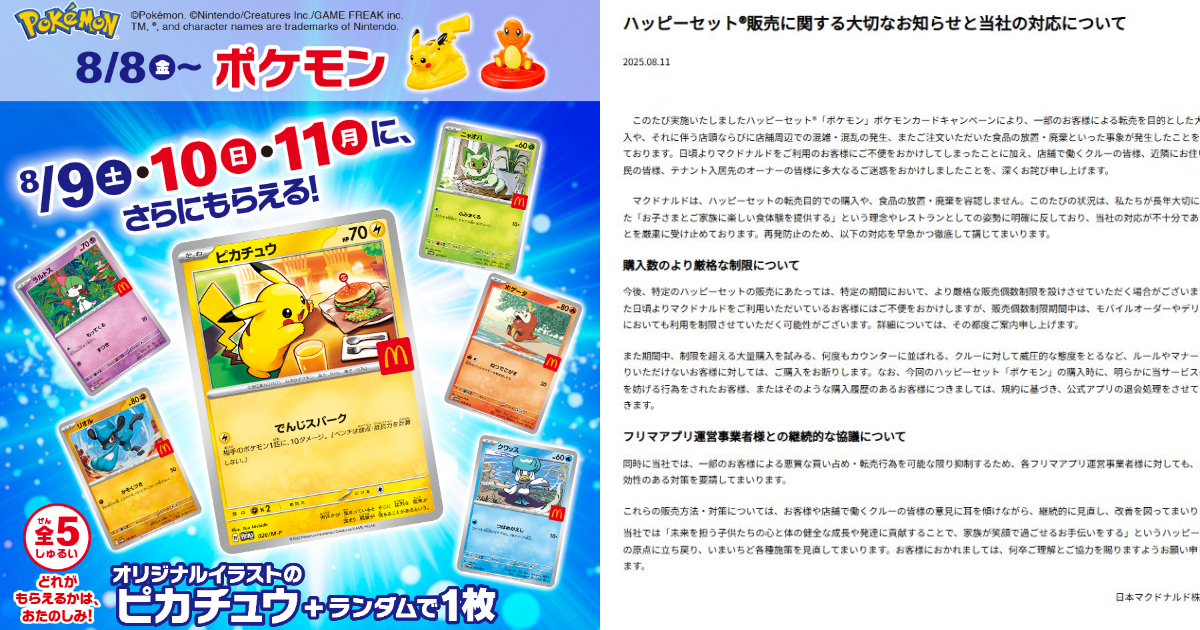
According to the official announcement:
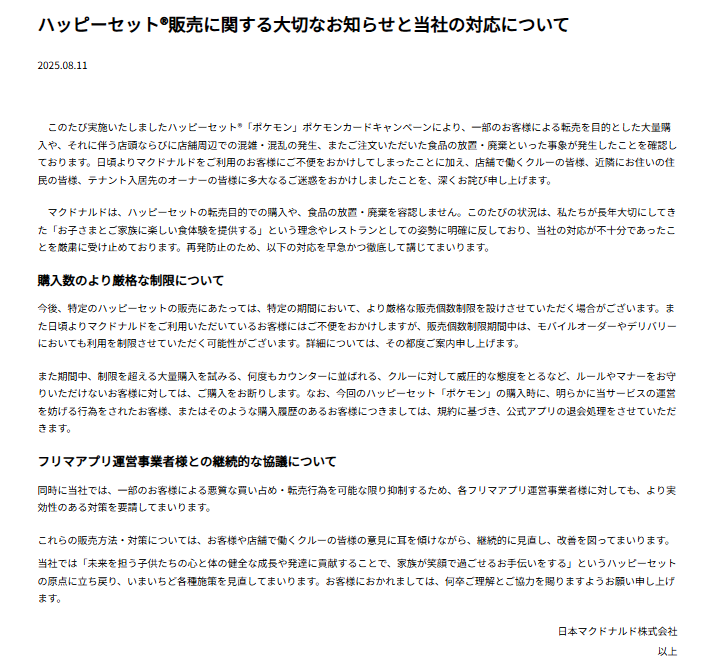
【Important Announcement Regarding Happy Meal Sales and Our Response】
Regarding the recent "Pokémon" Happy Meal card promotion, we have observed that some individuals purchased items in large quantities for resale purposes. This has resulted in crowding and confusion both inside and outside our restaurants, and in some cases, the purchased meals were discarded. This has not only inconvenienced our loyal customers but also created issues for our employees, local residents, and mall landlords. We sincerely apologize for this.
McDonald's does not condone the purchase of Happy Meals for resale or the wasting of food. This situation contradicts our long-held philosophy of "providing a fun dining experience for children and their families." It highlights our own shortcomings in managing the promotion, and we are treating this matter with the utmost seriousness to prevent future occurrences.
We will immediately implement the following measures:
1. Stricter Purchase Limits
For specific future Happy Meal promotions, we will enforce stricter purchase limits during the campaign period. These limits may also apply to mobile orders and delivery services, with details to be announced separately. During this time, we will refuse sales to customers who exceed the purchase limit, repeatedly line up, or exhibit intimidating behavior toward our staff. Furthermore, customers who significantly disrupted store operations during the "Pokémon" event or have a similar purchase history will have their official app memberships revoked in accordance with our policies.
2. Continued Cooperation with Resale Platforms
To curb malicious bulk buying and scalping, we will continue to work with major online marketplace operators to request more effective preventative measures. We will keep listening to feedback from our customers and frontline staff to continuously review and improve our sales methods and strategies.
McDonald's will return to the original purpose of the Happy Meal—"to support the healthy growth of children who will shape the future and to bring smiles to families"—and re-evaluate all our initiatives. We appreciate your understanding and cooperation.
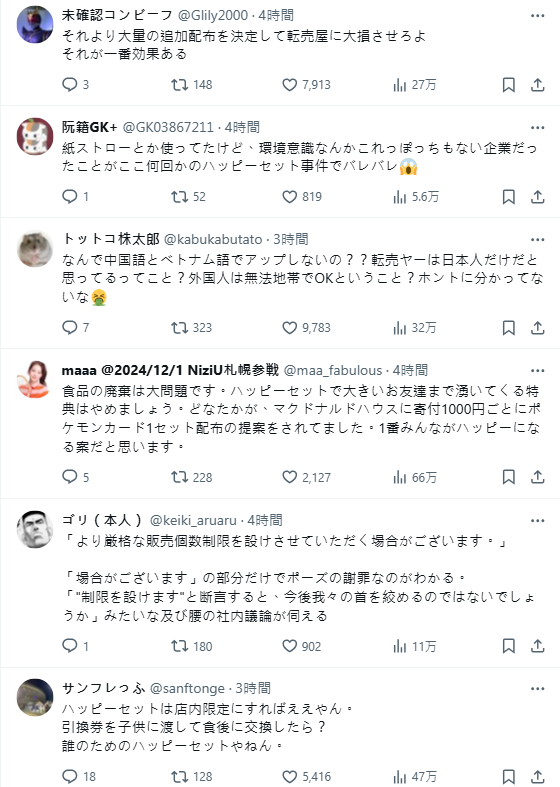
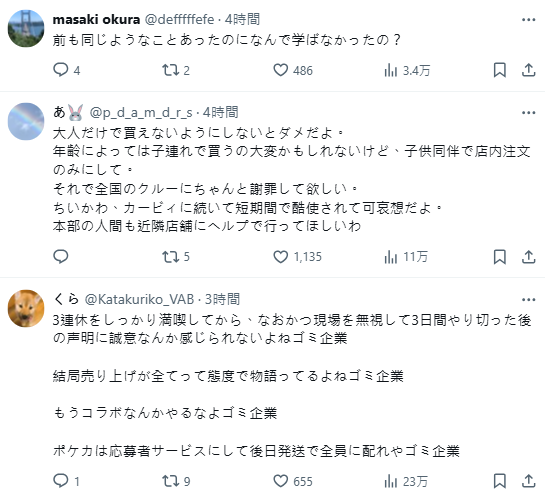
However, many users on X (formerly Twitter) were not buying the official apology, flooding the platform with complaints and suggestions. Ideas included selling the merchandise separately, doing a massive restock to devalue scalped goods, limiting eligible menu items to reduce chaos, and even making the promotion exclusive to dine-in customers who receive a voucher after their meal to ensure the toys reach children.
Many expressed concern that the scalping frenzy and food waste would leave a negative impression on kids. "The Happy Meal is making everyone unhappy," one user commented, urging the company to resolve the scalping issue once and for all to salvage its image.
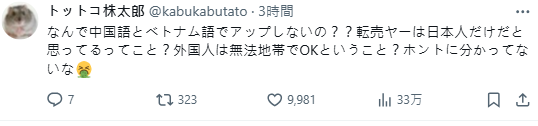
The fact that many of the bulk buyers were reportedly from China also fueled frustration among Japanese netizens, with some arguing that sales should be limited to residents to stop scalpers from clearing out stock.

Some users called out McDonald's management for being "insincere and only caring about revenue," criticizing the company for waiting until after the three-day holiday weekend (August 9-11) to issue a statement. They pointed out that similar chaos has plagued other popular Happy Meal collaborations this year, including *Kirby* and *Chiikawa*, with virtually no effective countermeasures, leaving both employees and genuine customers frustrated and questioning the company's commitment to fixing the problem.
This chaos was largely predictable. Although McDonald's had initially partnered with the resale platform Mercari to combat the issue, the marketplace was still flooded with listings, leaving many fans with no confidence in the company's strategy. It seems the fast-food giant needs to seriously rethink its approach to these popular collaborations before another one ignites a fresh wave of public anger.