

Kanto and Kansai have plenty of regional food quirks, but it turns out even the way people eat okonomiyaki (お好み焼き) can be completely different.
The debate began when a Japanese user on X/Social Media shared a YouTube video showing how okonomiyaki is cut differently in Kanto and Kansai. What started as a discussion about slicing methods soon revealed a much bigger divide: Kansai diners tend to eat an entire okonomiyaki by themselves, while people in Kanto see it as a dish meant to be shared.
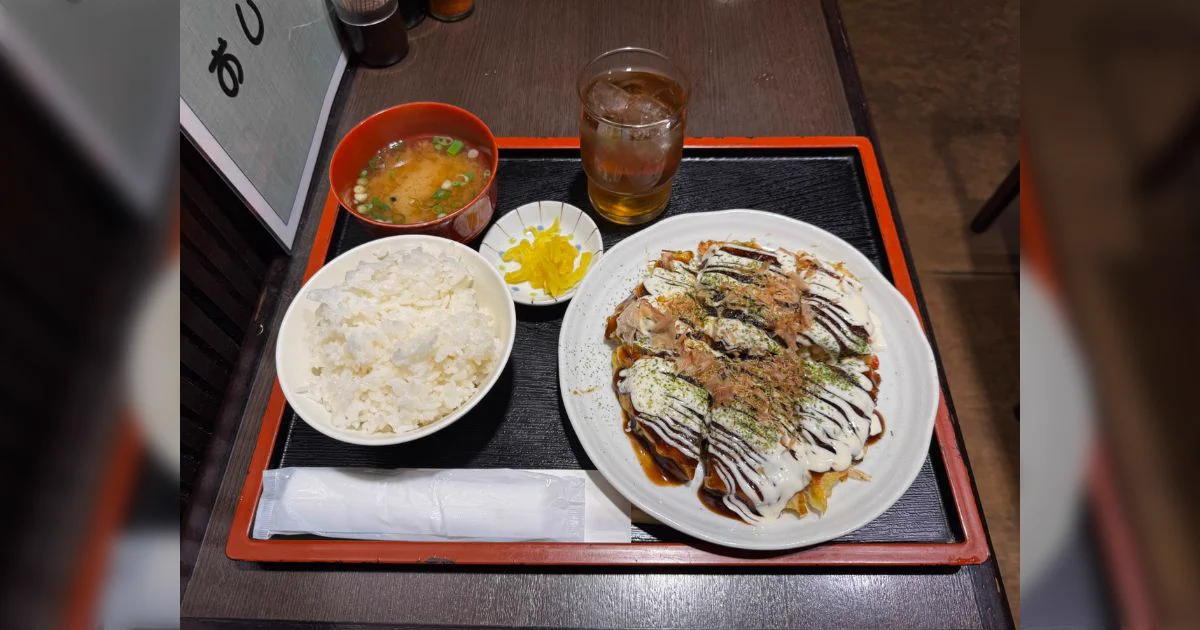
The conversation was sparked by an X/Social Media user named N@na, who posted a screenshot from a YouTube video demonstrating how okonomiyaki is cut and wrote in disbelief, “No way. Do people in Kanto really cut okonomiyaki like this?”
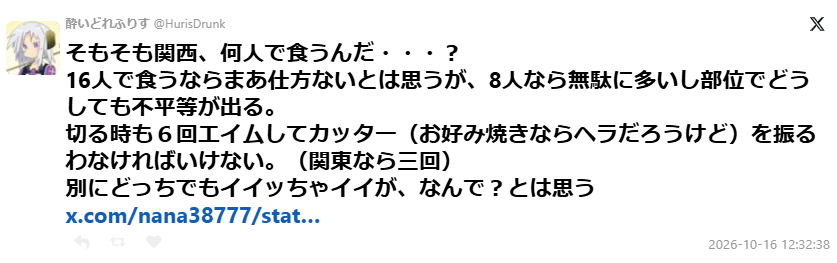
After seeing the Kansai-style cuts, one Kanto user questioned the logic. Dividing it that way might make sense for 16 people, they argued, but with only eight diners, there would be no need to slice it so finely. The uneven sizes of the pieces could also make sharing less fair.
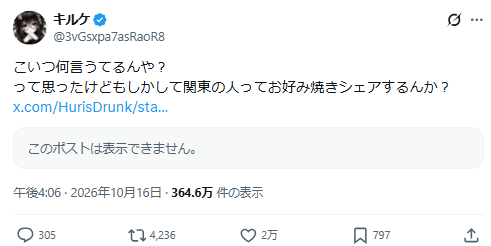
Kansai users were even more confused by that response. One fired back, “What is this person even talking about? Do people in Kanto all share their okonomiyaki?”
At that point, the conversation moved well beyond cutting techniques and zeroed in on a more fundamental question: Should one person eat an entire okonomiyaki, or should the table order several flavors and share them?
Kansai diners: “Isn’t it one okonomiyaki per person?”
As the debate spread, many Kansai users said they had grown up eating a whole okonomiyaki by themselves and had never even considered sharing one. Some said the idea of dividing an okonomiyaki had never crossed their minds, while others explained that everyone in their family had always eaten their own. To them, cutting it into pizza-style wedges made no sense at all.
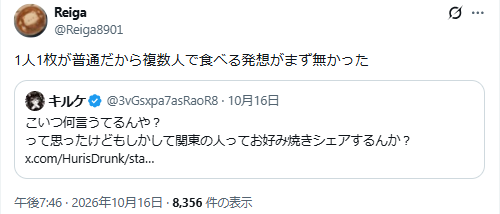
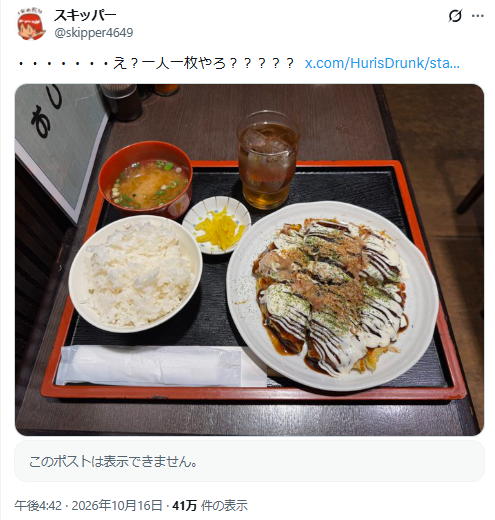
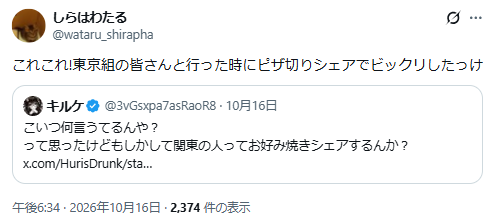
Another user recalled being surprised when friends from Tokyo cut their okonomiyaki into pizza-shaped slices so everyone could share.
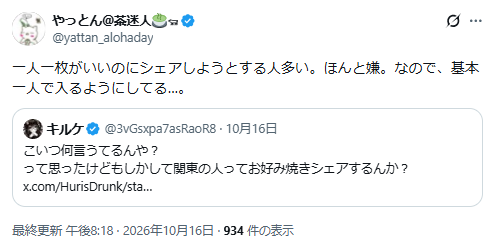
Some Kansai users said they actively dislike sharing when the obvious solution is simply to order one per person. A few even said they prefer eating okonomiyaki alone to avoid the issue altogether. For them, okonomiyaki is naturally a dish to enjoy on your own: everyone orders their favorite flavor, cuts it into manageable bites, and works through the whole thing at their own pace.
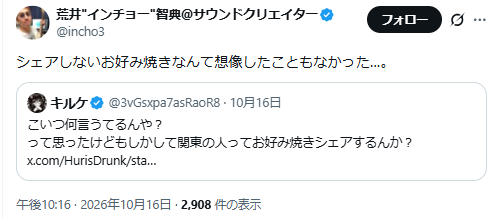
Kanto diners: “Isn’t the whole point to order different flavors and share?”
On the other side, many Kanto users found the idea of eating one entire okonomiyaki without sharing equally baffling. They had always assumed the table would order several flavors and divide them so everyone could try a little of each. When dining with friends, limiting everyone to the single flavor they ordered would take away half the fun.
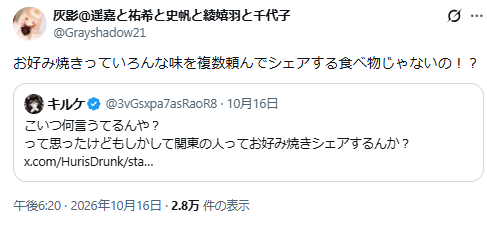
One user described the usual routine: the group picks a flavor, cooks it, shares it, then orders another flavor and repeats the process until everyone has sampled several different options.
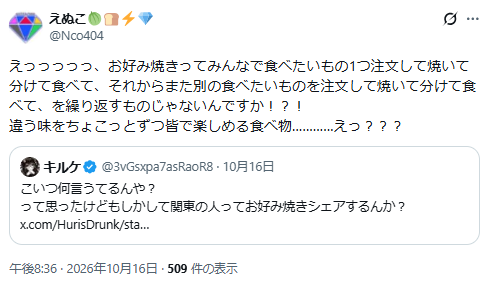
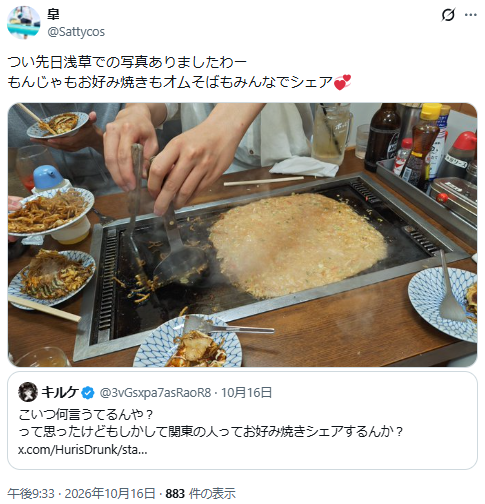
For these Kanto diners, okonomiyaki is like monjayaki or pizza: a social meal designed for groups to share and sample together.
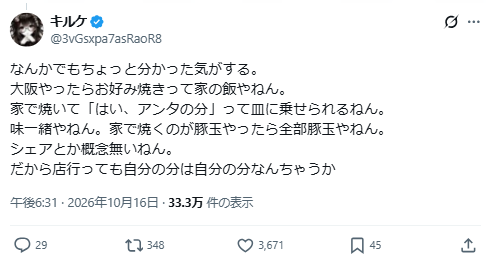
Among the many replies, one user offered a particularly convincing explanation. For many families in Kansai, okonomiyaki is simply an everyday home-cooked meal. The family cooks it at home, places each person’s serving on a plate, and everyone gets one to themselves.
For example, if the family decides to have pork okonomiyaki that day, everyone receives their own pork okonomiyaki. Families generally do not prepare several different flavors for everyone to share. Since each person already has an individual serving, there is no real reason to divide it up. Because okonomiyaki occupies this place in Kansai home cooking, the same “my serving is mine” mindset naturally carries over to restaurants.
What began as a debate over how to cut okonomiyaki ended up exposing a broader divide between everyday dining habits in Kanto and Kansai. For one side, okonomiyaki is a communal dish that lets everyone sample several flavors. For the other, it is a familiar home-cooked meal that naturally comes one per person.
It may look like a simple disagreement over slicing, but it reflects two very different ideas about how a meal should be enjoyed—and gave plenty of users a fresh look at the contrasting food cultures of Kanto and Kansai.